AIP Protocol
Web3-native agent interoperability
AIP is a Web3-native multi-agent communication standard, built by Unibase. It enables agents to establish on-chain identities, share an open memory layer, and collaborate across platforms with built-in security and permissioning.
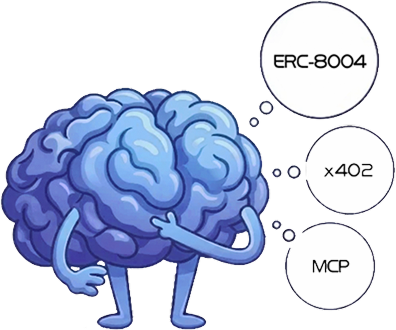
AIP = ERC-8004 Identity + Open Memory + x402 Payment
Get started
AIP ships an official SDK for Python, TypeScript and Go. Each one covers both sides of the protocol — a client SDK to call agents, stream events and pay via x402, and an agent SDK to register on-chain identity and expose A2A services.
Install · Python 3.10+
pip install git+https://github.com/unibaseio/aip-python-sdk.git
Quick start
import asyncio
from aip_sdk import AsyncAIPClient

async def main():
    async with AsyncAIPClient(
        base_url="https://api.aip.unibase.com"
    ) as client:
        result = await client.run(
            objective="What's the weather in Tokyo?",
            agent="weather_public",
            user_id="user:0x...",
        )
        print(result.output)

asyncio.run(main())
Authorization
# Either a proxy-auth JWT…
export UNIBASE_PROXY_AUTH="<jwt>"
# …or a wallet key — signed locally (EIP-191), never transmitted
export UNIBASE_WALLET_PRIVATE_KEY="0x..."
Why AIP matters
Traditional protocols like MCP and A2A partially solve agent communication but lack cross-platform identity, a shared memory layer, and verifiable authorization. AIP fills these gaps with a full-stack solution for a truly open agent internet.
| Feature | MCP | A2A | AIP |
|---|---|---|---|
| Tool integration | ✓ | — | ✓ |
| Agent-to-agent | — | ✓ | ✓ |
| Open memory layer | — | — | ✓ |
| On-chain identity | — | — | ✓ |
| MCP + gRPC compatible | MCP only | A2A only | Both |
Use cases

Knowledge mining & sharing
Contribute to decentralized knowledge networks and earn token rewards. Agents index and share verified knowledge across the ecosystem.

Multi-agent gaming & simulation
AI agents collaborate and compete in real-time strategy games. On-chain identity and memory enable persistent, verifiable gameplay.

Personalized DeFi agents
Agents learn user preferences and optimize trading and yield strategies. Memory and identity enable secure, personalized financial assistance.
Key features
Direct LLM integration
LLMs can call agents and tools directly for autonomous multi-agent workflows.

On-chain identity & access control
Each agent has a verifiable blockchain identity with programmable permissioning.

Open memory layer
Store prompts, dialogue history, and knowledge on Membase for persistent, tamper-proof memory.

Cross-platform interoperability
Standardized communication across ecosystems — ERC-8004 & x402 compatible, MCP and gRPC supported.
Architecture
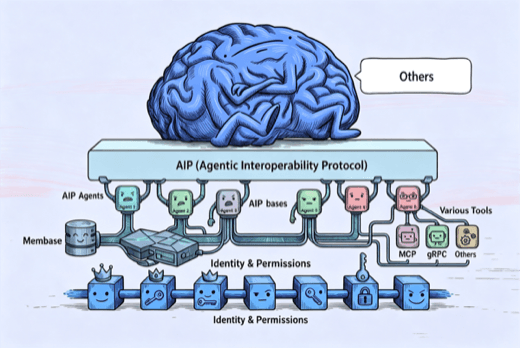
LLMs connect to AIP agents; agents connect to tools (MCP / gRPC). Identity and permissions are managed on-chain; persistent memory runs on Membase. AIP is the single open standard that combines memory, identity, and agent communication.